Google review removal cost in Canada
Free Google reporting, our CAD fees, partial-success totals and questions to ask before paying.
Open pricing guideThe ReviewRemoval journal
Start with Google review pricing, evidence and reporting guidance for Canadian businesses. Explore our original research on Google and other review platforms, with cited data and clear methods. Follow new articles via RSS.
Google review removal resources
Check the price, prepare the facts or follow a report already in progress. These guides are written for Canadian business owners dealing with Google Business Profile reviews.
Free Google reporting, our CAD fees, partial-success totals and questions to ask before paying.
Open pricing guideSeparate a suspicion from useful evidence, organize a review attack and prepare a focused case.
Open fake reviewsChoose the right reporting route, interpret the current status and prepare an eligible appeal.
Open reporting & appealsChoose the concern and reporting stage, then download a practical case worksheet. No sign-in.
Open free preparation toolDistinguish a delayed review, a missing review, a different listing and a removal decision.
Open missing reviewsAsk our team to handle your Google review removal request — CAD $50 upfront per review, plus $125 for each review removed.
Featured research
Our figures are drawn from linked platform publications, with calculations and limits shown beside the charts.
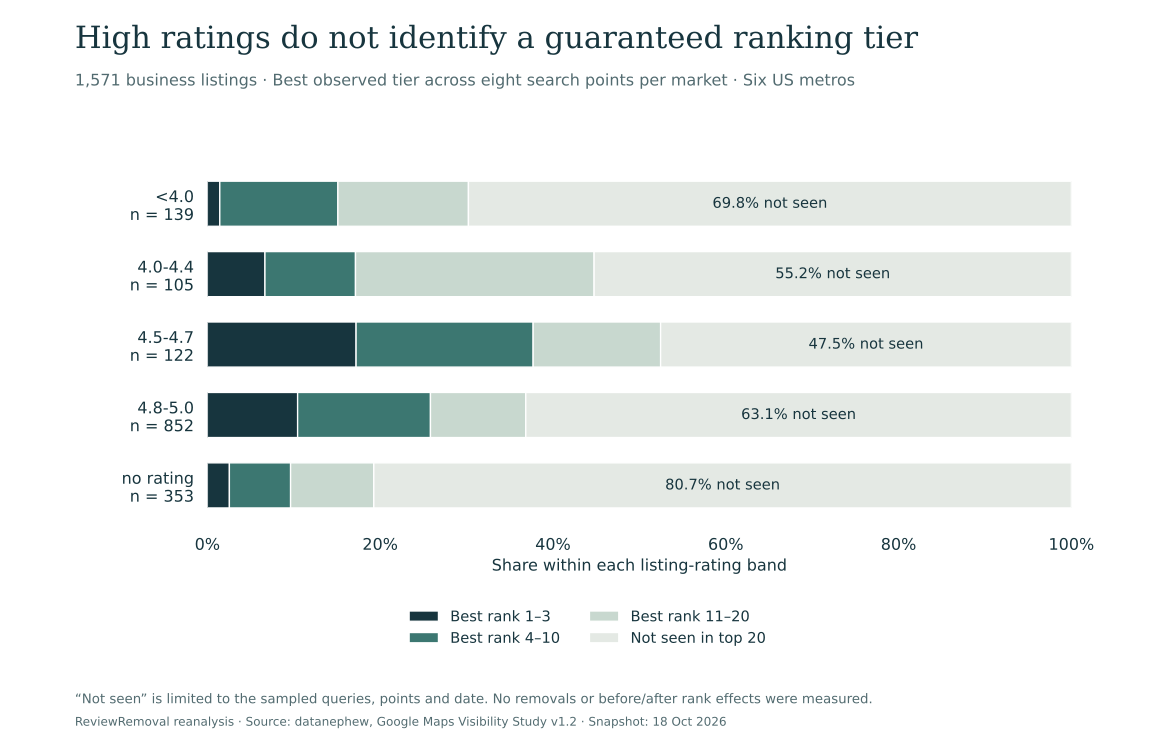
538 of 852 high-rating listings were absent from sampled top-20 results. A new aggregate audit explains why a better star rating and a better search position are different outcomes.
Read the studyMore to read
A one-hour median appears in Google’s latest Maps legal-notice table. We audit its categories, clock and missing fields, then show what a median leaves unknown about an individual review removal case.
A Google Maps appeal can challenge a removal—or challenge a refusal to act. Our audit of two 2026 releases separates those directions, publishes the calculations and explains the limits for Canadian businesses.
A percentage can be accurate and still answer the wrong question. We trace the population behind a published Google review risk score, then construct exact examples showing how much remains unknown about the whole business profile.
Google’s 15.4% fake-or-misleading figure uses all contributed reviews as its base. Our original audit tracks that denominator, the 245M-versus-240M distinction and reporting corrections that change how the numbers should be cited.
A displayed 4.4 hides more than one possible average. Our original sensitivity analysis shows when removing a one-star review changes the display, when the outcome is uncertain, and why review count matters.
Most reported reversals challenged a decision not to act on a notice. We reconstruct the appeal table, expose the missing reason breakdown and explain which denominator belongs in a citation.
A hidden review can return. We reconstruct a published recommendation matrix, separate movement from deletion, and show how to investigate changes without guessing.
Four reporting periods, three different denominators. We trace the fraud figures and explain why a platform-wide total cannot tell you whether a business report will succeed.
A Canadian government survey table puts Google Reviews activity at 63.8% for tourism SMEs and 47.0% across industries. We check the difference and explain what it does—and does not—measure.
A source-by-source audit of Google’s annual review enforcement figures, with downloadable data, original charts and the limits behind the headline numbers.
Trustpilot’s published breakdown reveals that most detected fake reviews it removed in 2024 were five-star. Here are the figures, calculations and important caveats.
Sixteen direct answers about Google, Facebook, Yelp, Trustpilot, Tripadvisor, Booking.com, Glassdoor and Indeed reporting, timelines, appeals and pricing.
A five-step checklist for turning a vague concern into a focused, policy-based report without overstating what you know.
Your review concern
Read our editorial standards, source policy and correction process. Platform-wide figures and mathematical examples do not measure our service outcomes.